Causes and Exposure
Do Air Purifiers Help With Mold? Name the Job First
MoldCo Editorial Team
The short answer
Contents
Four used air purifiers for $100 looked like a bargain. Then came $272 in replacement filters, competing claims about the smallest particles each machine could catch, and a dehumidifier already running for a crawlspace problem. After trying to make sense of the numbers, the buyer wrote, "im just concerned I wasted money." That worry is reasonable. Whether those machines were a good buy depends on the job they were bought to do.
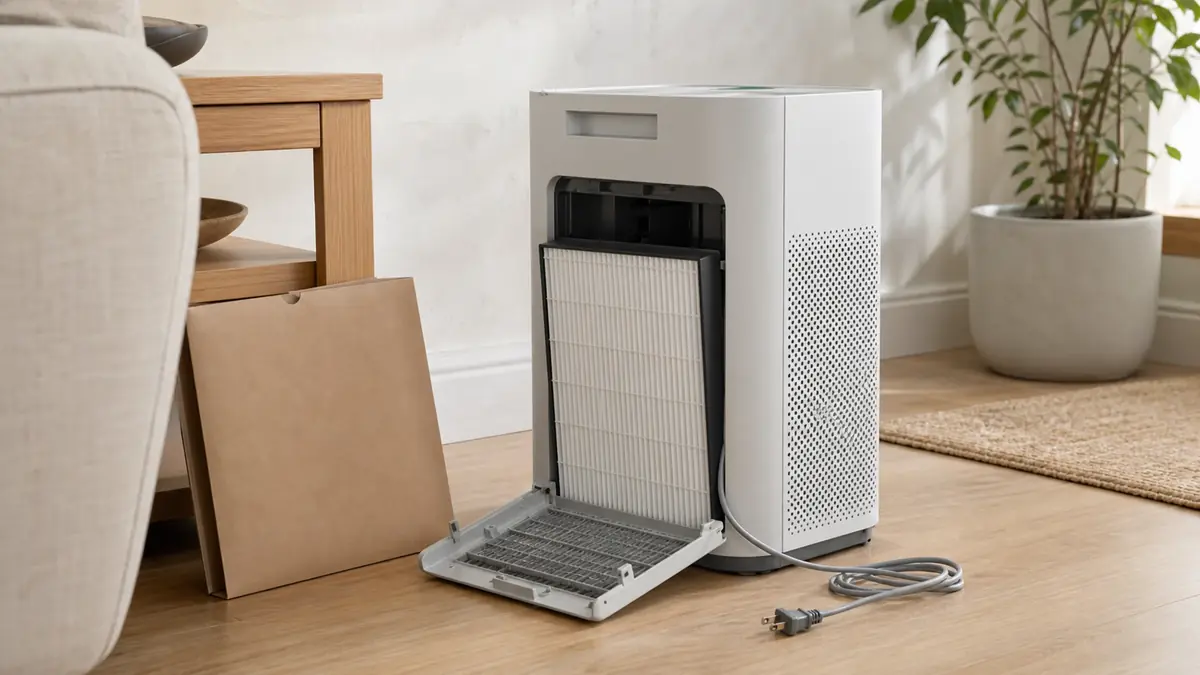
For a bounded job, yes: a properly sized portable air cleaner may reduce some mold-generated particles that are airborne while the machine runs. But filtration doesn't stop a leak, dry a damp wall, remove growth from material, clean settled dust by itself, certify a room, or tell you why someone feels ill. Air cleaning supports source control and ventilation; it doesn't fix mold or moisture, according to the EPA's guide to air cleaners in the home.
A purifier can be doing its limited job well while the building problem stays exactly where it was.
Put the building before the machine
Mold growth needs moisture. Find and correct water entry, dampness, or excess humidity first, as the EPA's mold guidance recommends. Then clean or remove affected material in a way that fits the size and condition of the problem. That same source-first sequence guides CDC/NIOSH advice on damaged material.
That order matters because airborne particles are only one part of what may be in a damp building. Growth can remain on drywall, wood, carpet, or belongings. Particles can settle onto surfaces. A musty odor may involve gases that a particle filter was never designed to measure. These are building questions, and MoldCo doesn't inspect or remediate buildings.
Once the source work is underway, give filtration one supporting job: it may lower some airborne particle concentrations in the room the machine serves.
HEPA describes media, not the room
HEPA is a laboratory classification for filter media. HEPA filter media is tested to remove at least 99.97 percent of particles at 0.3 micrometers, a size that's among the hardest for the filter to capture. It isn't a hard lower cutoff. It also doesn't tell you how much clean air the finished machine will deliver to your room. The EPA's HEPA explanation makes that filter-level boundary clear.
The complete device has to pull room air through the filter, move enough of it, and keep doing so at a setting you can live with. That whole-device delivery belongs ahead of a tiny "minimum particle size" number in the buying decision. A highly efficient filter paired with weak airflow may clean less room air than a well-built machine moving more air through suitable media.
For particle cleaning, look for the smoke clean air delivery rate, or smoke CADR. CADR is a whole-device measure of how quickly the machine supplies filtered air for a particular particle category. AHAM's room-sizing rule calls for a smoke CADR at least two-thirds of the room's floor area when the ceiling is 8 feet high.
Here is one practical example. A 12-by-15-foot room has 180 square feet of floor area. Under the AHAM two-thirds rule, an 8-foot-ceiling room that size calls for a smoke CADR of at least 120. That's a particle-cleaning comparison rule. It isn't a mold-remediation target, a clearance result, or a safety threshold. A higher ceiling or a room that opens into another space requires a larger room rating.
Buy for the setting you will actually use
Maximum performance on a label matters little if the highest fan setting is too loud to run. Before buying or keeping a purifier, check the details that decide what happens after the first week:
- Is the published smoke CADR adequate for the actual room?
- Can you tolerate the sound at the fan setting that produces that CADR?
- Can air enter and leave the unit freely where you plan to place it?
- Are replacement filters available, and can you afford to replace them on schedule?
- Will the machine run for long enough each day to do the job you bought it for?
Placement, runtime, fan speed, filter condition, and replacement burden all affect real use. The EPA's indoor filtration fact sheet is a useful operating check, even though its efficacy discussion focuses on smoke rather than mold outcomes.
Odor and particles are separate jobs
A musty smell doesn't grade the particle filter. CADR measures particle cleaning. It doesn't measure gas removal, and there's no widely used consumer gas-removal rating that works like CADR. Some machines add sorbent media such as activated carbon, which may reduce some gases when there's enough of the right media for the compounds present. A thin carbon sheet and a large sorbent bed aren't interchangeable.
This cuts both ways. A room can smell better while moisture and growth remain. It can also keep smelling musty while a particle filter reduces some airborne particles. Odor change isn't clearance, and persistent odor alone doesn't prove the purifier failed. The EPA's technical review of residential air cleaners separates particle removal from gas removal.
The same job confusion appears with mycotoxins. They may travel on spores, smaller fragments, or dust, but capturing some particles doesn't establish a universal consumer-purifier removal percentage. One often-cited study used a controlled chamber with contaminated wallpaper, while a later review found major uncertainty about transport and exposure in real buildings. That's too thin a foundation for a promise that "most HEPA purifiers remove mycotoxins."
Screen active technologies with more than a badge
When a device claims to react with pollutants instead of simply trapping particles, start with the occupied room. Keep ozone generators out of occupied spaces. Ozone can harm the lungs, and at concentrations that meet public-health limits it's generally ineffective against mold and other biological pollutants, as the EPA's guidance on ozone-generating air cleaners explains.
For other reactive air-cleaning technologies, a "kills mold" badge isn't enough. Look for independent testing of what the complete device removes and which byproducts it creates. The same testing should show how occupants are protected at the settings people actually use. That's the CDC/NIOSH screen for emerging air-cleaning technologies. A CARB-certified air cleaner has met an ozone-emissions requirement; that certification doesn't prove mold or odor control. It doesn't prove a health benefit either.
A laboratory kill claim still doesn't remove material from a wall, carpet, or settled dust. Physical cleanup and moisture correction remain necessary even when a technology can inactivate an organism under test conditions.
Follow the order of operations
Use one purchase rule: name the purifier's bounded room-level particle job while moisture correction and cleanup address the building. If you can't locate the source or judge its extent, bring in an independent environmental professional before treating another machine as the answer.
Any health-related claims made on this site have not been evaluated by the Food and Drug Administration (FDA). The information provided on this site is not intended as a substitute for professional medical advice, diagnosis, or treatment. Always seek the advice of your physician or other qualified health provider with any questions you may have regarding a medical condition. MoldCo assumes no responsibility or liability for any errors or omissions in the content of the references, nor for any actions taken in reliance thereon.
About the author

MoldCo Editorial Team
Editorial Team
The MoldCo Editorial Team maintains MoldCo's public education library. The team works from MoldCo's product, clinical, and environmental review standards to keep content clear, sourced, and within appropriate medical and remediation boundaries.
Your next step
Not sure whether mold is part of your picture?
The first step is an intake that maps your symptoms and history. You get clarity first, then decide whether provider-guided care fits.
This article is informational and is not medical advice. MoldCo treats but does not diagnose CIRS.
Keep reading
Causes and Exposure
5 Signs of Black Mold in Your House: What the Clues Can Tell You
August 14, 2026 · 6 min read
Causes and Exposure
Mold on Walls: What to Do When It Keeps Coming Back
July 29, 2026 · 6 min read

Causes and Exposure
Pink Mold: What It Is, How to Clean It, and When to Look Deeper
July 29, 2026 · 6 min read