Testing Guide
Does vinegar kill mold? What it can and can't fix
MoldCo Editorial Team
The short answer
Contents
- Why killed is not fixed
- The surface matters before the cleaner
- If mold comes back after vinegar
- When you should not be the one disturbing it
- What testing can and cannot tell you
- Quick answers
- Does vinegar kill mold?
- Can vinegar kill mold on drywall?
- Why does mold come back after vinegar?
- Is dead mold still a problem?
- Should I test after cleaning mold?
- Medical disclaimer
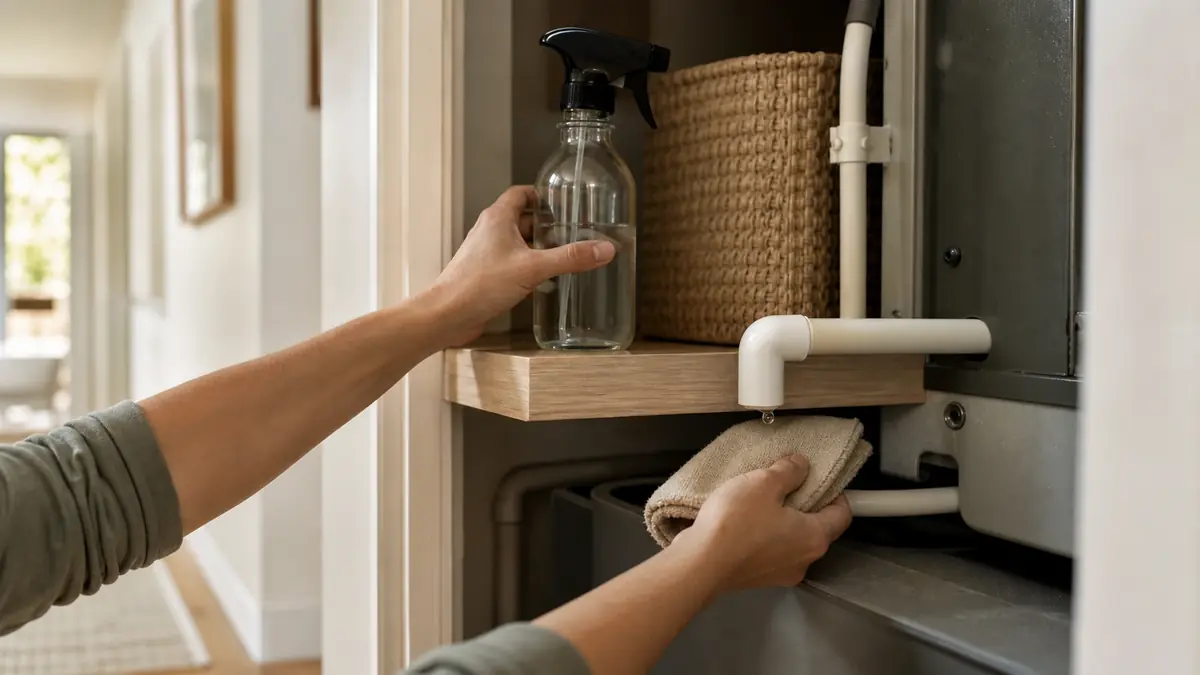
A ceiling spot near an AC line gets sprayed. Sometimes with vinegar, sometimes with bleach. The dark mark fades a little, or it doesn't. Then the growth comes back.
At that point, the useful question is no longer just "does vinegar kill mold?" It is what the mold is growing on, what is keeping the area wet, and what is still left behind after the visible spot changes.
Vinegar may affect some small visible surface mold in limited direct-contact situations. Acetic acid has shown antifungal activity under controlled disinfectant-study conditions, but that doesn't prove household vinegar remediates drywall, carpet, insulation, HVAC-adjacent material, hidden growth, or a space that keeps getting wet (Frontiers in Cellular and Infection Microbiology).
The safer answer is this: vinegar can be a surface cleaner in some situations. It is not mold remediation. EPA's core mold-control guidance is to fix the water problem, clean up the mold, and dry wet materials quickly (EPA). If the source of moisture is still there, the cleaner is never the main fix.
Why killed is not fixed
Mold cleanup is not only a chemistry problem. Even if a chemical affects visible growth, that does not answer whether contaminated material was cleaned or removed, whether dust and fragments remain, or whether the area is still damp.
EPA makes a similar point in its bleach guidance. Routine use of a biocide is not generally recommended for mold cleanup, sterilizing a moldy area is usually not possible or desirable, and dead mold can still cause allergic reactions in some people (EPA).
That does not mean every small spot is a crisis. It means "killed" is the wrong finish line. The better finish line is a dry source, cleanable or removed material, less residue, and no obvious path for the mold to return.
The surface matters before the cleaner
A small spot on a hard, nonporous surface is different from mold in drywall, ceiling material, carpet, insulation, wood that stayed wet, or an HVAC-adjacent area. EPA separates hard surfaces from absorbent materials because mold can be difficult or impossible to remove completely from some porous materials (EPA).
That distinction matters more than the spray bottle. If the moisture source is fixed and the spot is on a hard surface, surface cleaning may be a reasonable household task for someone who can clean it safely. If the growth is in porous material or near a recurring moisture source, vinegar on the face of the surface cannot tell you the problem is resolved.
Dark staining after cleaning is hard to interpret for the same reason. A stain can be cosmetic. It can also be a clue that the material history is not simple. Do not use stain change as proof that the source, material, and residue are handled.
If mold comes back after vinegar
Mold that comes back is usually pointing away from cleaner choice and toward source control. Look for what keeps the area damp: a leak, condensation, poor ventilation, an AC or HVAC moisture path, damp insulation, a bathroom fan that is not exhausting properly, or water-damaged material that was never removed.
EPA also gives practical stop points. If the affected area is larger than about 10 square feet, if there has been significant water damage, if HVAC systems may be contaminated, if contaminated water is involved, or if there are health concerns, the problem can move beyond casual do-it-yourself cleanup (EPA).
For source-control decisions, MoldCo's mold remediation guide can help you think through cleaning, source correction, and remediation. MoldCo offers education and its HERTSMI-2 Home Test Kit. Independent medical entities provide clinical services through the platform. MoldCo does not inspect homes or perform remediation.
If the source needs to be found, a home needs remediation, or a project needs clearance, that is an environmental job. It is not a vinegar job, and it is not a MoldCo clinical service.
When you should not be the one disturbing it
Cleanup can create exposure while material is being disturbed. CDC cautions that mold cleanup can carry health and injury risks, and that people with mold allergies, asthma, COPD, immune suppression, or other underlying health risks may need to avoid cleanup exposure or ask a medical professional before doing it themselves (CDC).
That boundary matters most when the person asking about vinegar is already symptomatic or mold-susceptible. Visible mold does not prove their symptoms are from mold. It does mean the person most worried about symptoms may not be the right person to scrub, sand, tear out, or disturb moldy material.
What testing can and cannot tell you
Visible or recurring mold is different. In most cases, remove it and identify and correct the moisture source, usually through visual inspection, rather than sampling. EPA says sampling is usually unnecessary when visible mold growth is present. Because there are no federal limits for mold or mold spores, sampling cannot be used to check a building's compliance with federal mold standards.
Testing becomes relevant when the cleaner question has turned into a building-side uncertainty question and no mold is visible. That can happen when the source is hidden, the area is HVAC-adjacent, a musty odor persists, remediation already happened and confidence is low, or someone mold-susceptible is trying to understand whether a space may still be a problem.
Testing cannot tell you whether vinegar made a home safe for a particular person. CDC/NIOSH notes that there are no health-based standards for mold in indoor air, routine air sampling is not recommended for many building air-quality evaluations, and short-term spore counts or culture results cannot be interpreted as personal health-risk measurements (CDC/NIOSH).
MoldCo's Mold Home Test Kit is a $199 HERTSMI-2 settled-dust test that ships to your home, is available in all 50 U.S. states, returns results in roughly 1 to 2 weeks, and tests for five mold species commonly associated with water-damaged buildings. It can add building-side dust information when no mold is visible and the question involves suspected hidden growth, an HVAC-adjacent concern, a persistent musty odor, or uncertainty after cleanup.
It does not diagnose illness, prove symptoms were caused by mold, replace an inspection when a source must be found, remediate a home, certify that a home is safe, or serve as a vinegar alternative.
If your cleanup question is also tied to chronic symptoms plus suspected exposure, MoldCo's questionnaire can help organize whether mold-related illness is worth evaluating. It does not diagnose, prove causation, or replace medical care.
Quick answers
Does vinegar kill mold?
Vinegar may affect some small visible surface mold in limited direct-contact situations, but it is not mold remediation. The source, moisture, material, residue, and recurrence pattern matter more than the spray.
Can vinegar kill mold on drywall?
Do not treat moldy drywall as a simple vinegar question. Porous or absorbent materials can hold contamination beyond the surface, and EPA warns that some porous materials may be difficult or impossible to clean completely.
Why does mold come back after vinegar?
Mold that comes back usually means moisture, hidden growth, contaminated material, poor ventilation, or another source was never handled. Repeating the cleaner rarely answers those questions.
Is dead mold still a problem?
It can be for some people. EPA says dead mold can still cause allergic reactions in some people, so killing visible growth is not enough. The mold still needs cleanup or removal.
Should I test after cleaning mold?
If mold is visible or keeps returning, remove it and identify and correct the moisture source, usually through visual inspection; sampling is usually unnecessary. When no mold is visible, settled-dust testing can add context to suspected hidden growth, an HVAC-adjacent concern, a persistent musty odor, or uncertainty after cleanup. Do not use a test as a diagnosis, a safety certificate, or a replacement for finding and fixing the source.
Medical disclaimer
Any health-related claims made on this site have not been evaluated by the Food and Drug Administration (FDA). The information provided on this site is not intended as a substitute for professional medical advice, diagnosis, or treatment. Always seek the advice of your physician or other qualified health provider with any questions you may have regarding a medical condition. MoldCo assumes no responsibility or liability for any errors or omissions in the content of the references, nor for any actions taken in reliance thereon.
About the author

MoldCo Editorial Team
Editorial Team
The MoldCo Editorial Team maintains MoldCo's public education library. The team works from MoldCo's product, clinical, and environmental review standards to keep content clear, sourced, and within appropriate medical and remediation boundaries.
Your next step
Not sure whether mold is part of your picture?
The first step is an intake that maps your symptoms and history. You get clarity first, then decide whether provider-guided care fits.
This article is informational and is not medical advice. MoldCo treats but does not diagnose CIRS.