Symptoms
How dangerous is black mold? Color isn't the risk test
MoldCo Editorial Team
The short answer
Contents
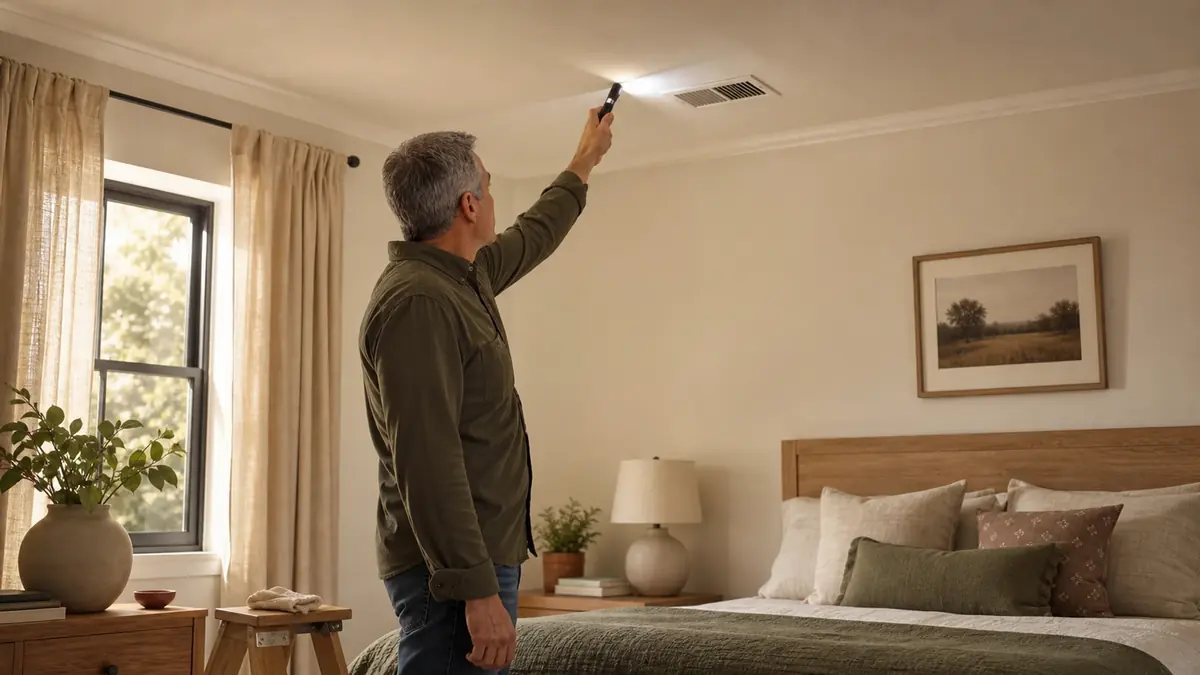
A dark patch shows up on ceiling drywall near an AC unit. Someone sprays it, scrubs it, watches the stain fade a bit, then sees it come back.
That's the real black-mold question for most people: is this bad enough to change how I use the room, clean the space, test the home, or think about my health?
The scene proves the pressure of the decision. It doesn't prove the species, whether cleaning worked, whether the room is safe, or whether the building caused anyone's symptoms. Black mold can be dangerous in some situations, but color alone doesn't tell you how dangerous it is. CDC says mold can look like spots of many colors, and if you see or smell mold, you should remove it and fix the moisture problem. The better risk assessment is the presence of moisture, whether visible growth is active or returns after cleanup, impacted material, hidden or HVAC-adjacent growth, who is exposed, what symptoms are present, and what evidence would actually answer the open question.
Visible mold is different. In most cases, remove it and identify and correct the moisture source, usually through visual inspection, rather than sampling. EPA says sampling is usually unnecessary when visible mold growth is present. Because there are no federal limits for mold or mold spores, sampling can't be used to check a building's compliance with federal mold standards.
Color doesn't answer the question about risk
"Black mold" usually means dark indoor mold, and sometimes people use it to mean Stachybotrys chartarum. CDC describes Stachybotrys chartarum as a greenish-black mold that can grow on wet, cellulose-rich materials such as gypsum board, fiberboard, and paper.
But that same CDC guidance matters more than the color: no test proves an association between Stachybotrys chartarum and particular health symptoms, and Stachybotrys and other molds should be treated similarly for potential health risks and removal.
So the color can tell you something is growing. It can't give you a personal danger score.
The better question is: what is feeding the growth? A small patch on a hard surface isn't the same as recurring growth on ceiling drywall, a musty wall cavity, a roof leak, or mold near HVAC equipment. For more on black mold types and related reading, use MoldCo's black mold guide. This page is about the danger decision.
Start with the building lane
Visible or smelled mold should be treated first as a building-related moisture problem. EPA's core mold guidance is plain: mold control is moisture control. If mold is present, clean up the mold and fix the water problem. EPA also notes that porous materials such as ceiling tile and carpet may be difficult or impossible to clean completely.
Recurring dark mold after cleaning is a sign to stop treating the patch as only a surface-cleaner question. It may point to condensation, ventilation, a hidden leak, damp porous material, or growth that needs qualified environmental attention. That doesn't mean every dark patch is a disaster. It means the next question is source control, not species panic.
MoldCo doesn't inspect homes, remediate buildings, certify that a space is safe, or create legal documentation. If growth is extensive, hidden, recurrent, tied to water damage, on porous material, or near HVAC equipment, the building lane may need a qualified inspector or remediator before any health or product question is useful.
Then ask who is being exposed
Mold health risk isn't the same for every person. CDC says damp and moldy environments may cause health effects in some people and none in others. The most mainstream-supported risks are respiratory, allergic, irritant, asthma-related, hypersensitivity, and susceptible-person risks. EPA similarly emphasizes allergic reactions, asthma attacks in people with asthma who are allergic to mold, and irritation of the eyes, skin, nose, throat, and lungs.
WHO's dampness and mould guideline treats indoor dampness and microbial growth as a public-health issue tied especially to respiratory symptoms, allergies, asthma, and immune effects. The National Academies report supports associations between damp indoor environments and upper respiratory symptoms, cough, wheeze, asthma symptoms in sensitized people, hypersensitivity pneumonitis in susceptible people, and severe fungal infection risk in severely immunocompromised people (National Academies report).
"Is it dangerous?" depends partly on who is in the space. Someone with asthma, mold allergy, chronic lung disease, immune compromise, severe respiratory symptoms, serious allergic reaction, infection concern, pregnancy or pediatric concerns, or crisis-level distress shouldn't use a blog article or MoldCo call to action (CTA) as the first stop. CDC says invasive mold infections (IMIs) are rare. While most people are not at risk, IMIs can be severe and life-threatening in individuals with weakened immune systems.
Symptoms deserve interpretation, not a shortcut
Symptoms can make mold worth investigating. They can't prove that a black patch caused the symptoms. CDC's Stachybotrys guidance makes that boundary explicit: no test proves an association between Stachybotrys and particular health symptoms.
This distinction matters because mold worry often starts after two things collide: a visible building problem and a body that doesn't feel right. Coughing, wheezing, congestion, eye irritation, skin irritation, fatigue, brain fog, or multisystem symptoms may all raise real questions, but many conditions can overlap with those symptoms.
The wrong shortcut can hurt in both directions. If you assume mold explains everything, you may miss asthma care, infection care, allergy care, primary care, or another diagnosis. If you assume mold can't matter because the evidence is not absolute, you may leave a water-damaged environment unaddressed.
For symptom-specific follow-up, use MoldCo's black mold symptoms guide. This article's narrower job is to sort what kind of danger question you are facing.
Testing answers narrower questions than people want
Most people want one test to say: this home is safe, or this mold is making me sick. Mold testing doesn't work that simply.
CDC/NIOSH says there are no health-based standards for mold or other biological agents in indoor air, and it doesn't recommend routine air sampling for many building air-quality evaluations. Short-term air samples may not represent actual exposures, and spore counts from short-term samples can't be interpreted in relation to health risks. CDC/NIOSH also says visual inspection and musty odors are often more reliable than air sampling for finding dampness and mold problems.
That doesn't make every test useless. It means the test has to match the question.
A building-related test can add context when the open question is hidden moisture suspicion, HVAC-adjacent growth, musty odor, or post-cleanup or post-remediation uncertainty and no mold is visible. A symptom questionnaire can help organize a body-related question when an adult has persistent symptoms plus credible exposure context. Neither one diagnoses illness, proves causation, or certifies a home safe.
How to choose the next step
If the open question is the building, start with moisture and source control. Visible mold, musty odor, recurrence, hidden moisture, HVAC-adjacent growth, or porous material should push you toward environmental investigation or qualified cleanup advice before you try to interpret symptoms.
If the open question is your body, start with medical interpretation. Severe symptoms, immune compromise, chronic lung disease, asthma, serious allergic reactions, pregnancy concerns, pediatric concerns, infection concern, or severe emotional distress belong with qualified care first.
If you are an adult with persistent unexplained symptoms plus credible mold or water-damage exposure, MoldCo's questionnaire can help organize whether mold-related illness is worth evaluating, but it doesn't diagnose or prove causation. Recurring visible growth needs removal rather than testing, and an environmental assessment may be needed to determine the scope of remediation. When no visible mold is present and your main uncertainty is hidden moisture suspicion, musty odor, cleanup, or post-remediation conditions, MoldCo's Mold Home Test Kit can provide HERTSMI-2 settled-dust context; it's a $199 ship-to-home dust test available in all 50 U.S. states, with results in roughly 1 to 2 weeks, but it doesn't diagnose illness, measure personal health risk, replace inspection or remediation, create legal documentation, or certify safety.
The point isn't to underreact or overreact. It's to stop asking color to answer a question color alone can't answer.
Medical disclaimer
Any health-related claims made on this site have not been evaluated by the Food and Drug Administration (FDA). The information provided on this site is not intended as a substitute for professional medical advice, diagnosis, or treatment. Always seek the advice of your physician or other qualified health provider with any questions you may have regarding a medical condition.
About the author

MoldCo Editorial Team
Editorial Team
The MoldCo Editorial Team maintains MoldCo's public education library. The team works from MoldCo's product, clinical, and environmental review standards to keep content clear, sourced, and within appropriate medical and remediation boundaries.
Your next step
Not sure whether mold is part of your picture?
The first step is an intake that maps your symptoms and history. You get clarity first, then decide whether provider-guided care fits.
This article is informational and is not medical advice. MoldCo treats but does not diagnose CIRS.