Care and Treatment
Mold on the ceiling: what to check before you touch it
MoldCo Editorial Team
The short answer
Contents
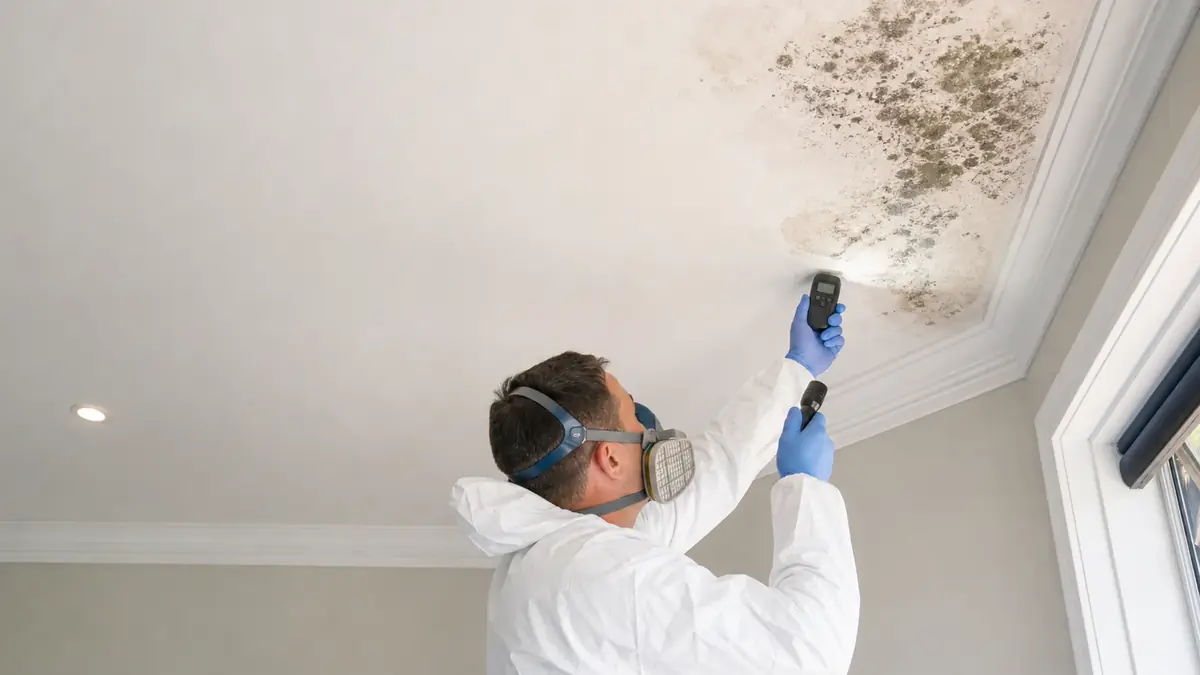
If you find suspected mold or changed material on a ceiling, check for active water and the condition of the material before you touch it. A wet, softened, or separating ceiling calls for a pause, not a scrape-and-see experiment.
That pause matters when, as one renter put it, "the ceiling over time has deteriorated" and "pieces are hanging down". If that's what you see, leave the area alone until someone on site can examine the ceiling assembly and decide how the material should be handled.
The mark itself is a branch point, not a verdict. It starts a moisture-and-material investigation. The EPA's moisture-control guidance describes several ways water can reach or collect in building materials, including rain entry, plumbing, condensation, and mechanical systems. Start with the most plausible route, then let findings from the building narrow the answer.
Pause before you disturb changed material
Pause and get qualified on-site judgment when water is active. Pause if the ceiling is wet or softened, or if material is coming apart.
A wide affected area or recurring growth also calls for on-site judgment. So do possible contamination above the visible surface, contaminated water, uncertain hidden conditions, or HVAC involvement. The EPA's home cleanup guidance supports that decision when water damage or material condition complicates the work. Its remediation guidance addresses hidden conditions and air-handling systems.
A qualified building professional can inspect the assembly, look for active water, judge the material in place, and define what needs attention. A photograph can't supply those findings. MoldCo doesn't provide inspection or remediation services. Our mold inspection and detection guide explains what an assessment should cover, while the mold remediation guide explains how assessment and remediation differ.
People with immune suppression, underlying lung disease, asthma, COPD, or significant mold allergy shouldn't take part in mold cleanup, according to the CDC's cleanup guidance. This boundary belongs at the start of the decision. It doesn't make every ceiling safe for everyone else to disturb.
Let location choose the first check
After the immediate water-and-material decision, location sets the first inspection path.
Near the top floor or an exterior roof edge, inspect the roof and ceiling assembly for rain entry, flashing trouble, or wet material above the finish. A mark there moves that route to the front of the line.
Below a bathroom or kitchen, inspect the plumbing route, including supply lines, drains, fixtures, and penetrations. Check any mechanical equipment above the ceiling separately.
At a cool ceiling surface, especially in a bathroom or exterior corner, check indoor humidity and exhaust. Look at insulation and air movement, then check whether the surface is collecting condensation. The EPA describes condensation on cool surfaces as a different moisture route from rain or plumbing entry.
Near a vent, air handler, or condensate path, inspect the HVAC-related moisture route and the surrounding material. Don't assume a dark mark is "vent dust," and don't assume the vent caused mold. Suspected contamination inside an air-handling system changes the scope and calls for qualified evaluation rather than casual disturbance.
This is how to handle the common "a leak problem or humidity problem" uncertainty. Location can set the inspection order; it can't supply the verdict. Inspect the most plausible route first, then follow what the building shows.
That first route is provisional. If the condition returns after cleaning or painting, recurrence sends the investigation back to moisture and material. The next check may need to change.
Let material and recurrence change the answer
Ceiling material makes the handling question specific. The EPA's brief guide to mold and moisture says hard surfaces may often be cleaned, while porous materials can be difficult or impossible to clean completely. Drywall facing and acoustic ceiling tile are absorbent. An intact painted surface may behave differently, yet paint doesn't make every ceiling assembly equivalent. The material and its condition need to be judged in place.
Recurrence should change your next move. If a mark returns after surface treatment, or "the mold continued to return," look again for moisture and assess the affected material. Repeating the treatment doesn't answer why the surface became hospitable again. Our guides to whether bleach kills mold and what vinegar can and can't fix explain that practical limit. Recurrence supports another inspection; it doesn't prove hidden growth, a continuing leak, or one particular source.
Keep color, health, and testing in separate lanes
Read black color as appearance, not identification. CDC and NIOSH advise that color doesn't rank mold as more or less dangerous, and CDC's Stachybotrys facts don't support identifying it from a photograph. That doesn't make dark growth harmless. It deserves the same moisture-and-material investigation without turning color into a species label or personal-risk score. Our black mold guide explains that boundary in more detail.
Health questions need different evidence. The CDC describes respiratory and allergic effects associated with damp or moldy environments, including irritation and asthma-related effects. The World Health Organization reports population-level respiratory and allergy associations, including asthma. Those findings support taking a damp building seriously. They don't show that one ceiling condition caused one person's symptoms. A qualified health professional can evaluate persistent or concerning symptoms while a building professional investigates moisture and material.
Sampling earns its place only when the result could change a named building decision. With visible growth, the immediate work is to address moisture and decide how the material should be handled. Routine short-term air sampling can't turn a spore count into a personal health-risk score or certify that a room is safe. A qualified assessor may still design sampling around a narrow question, such as, "Is suspected growth present on material inside this specific inaccessible cavity?" The plan should say how each possible answer would change the next building step. Our complete mold testing guide starts with that decision instead of the sample.
Route the remaining question to the person who can answer it. A qualified health professional evaluates symptoms and individual causation. For building questions, an on-site professional investigates water entry and hidden extent, then judges material condition and remediation scope. A qualified assessor can decide whether a focused sample would answer a building question.
If you need a clearance or safety decision, name that need before testing and ask what evidence it requires. Legal documentation also requires evidence chosen for that specific purpose. MoldCo doesn't provide inspection or remediation services.
Resolve the next building question
Start with the ceiling itself. Determine whether water is active and whether the material has softened or detached. Then inspect the most plausible route into or through the assembly. If the surface was treated before, record whether the condition returned.
Follow that order. The mark has already done its useful job: it showed you where to begin. Let a qualified person use the on-site findings to decide what the ceiling needs next.
Medical disclaimer
Any health-related claims made on this site have not been evaluated by the Food and Drug Administration (FDA). The information provided on this site is not intended as a substitute for professional medical advice, diagnosis, or treatment. Always seek the advice of your physician or other qualified health provider with any questions you may have regarding a medical condition. MoldCo assumes no responsibility or liability for any errors or omissions in the content of the references, nor for any actions taken in reliance thereon.
About the author

MoldCo Editorial Team
Editorial Team
The MoldCo Editorial Team maintains MoldCo's public education library. The team works from MoldCo's product, clinical, and environmental review standards to keep content clear, sourced, and within appropriate medical and remediation boundaries.
Your next step
Not sure whether mold is part of your picture?
The first step is an intake that maps your symptoms and history. You get clarity first, then decide whether provider-guided care fits.
This article is informational and is not medical advice. MoldCo treats but does not diagnose CIRS.
Keep reading

Care and Treatment
Mold detox treatment: the sequence before the stack
July 20, 2026 · 7 min read

Care and Treatment
Mold Poisoning Treatment Starts with Two Questions
June 9, 2026 · 7 min read

Care and Treatment
Cholestyramine Side Effects: What to Expect and When to Talk to Your Provider
May 18, 2026 · 8 min read