Testing Guide
White Mold: What the Color Can and Cannot Tell You
MoldCo Editorial Team
The short answer
Contents
"White chalky stuff on the basement walls" is a useful description. It tells us what someone sees and where it sits. It can't tell us whether the mark is mineral salt, fungal growth, or something else. It can't tell us whether a room is safe.
White is an appearance, not an identity or a danger category. Molds grow in many colors, and color doesn't indicate whether mold is more or less dangerous. On masonry, the white material may instead be efflorescence. On wood, drywall, or a painted surface, the possibilities and the response change again.
We ask one white mark to do too much. We want it to name the material, rank the danger, and choose the remedy. Appearance can begin that inquiry. The material under the patch and the path of the moisture decide what happens next.
Start with the material under the patch
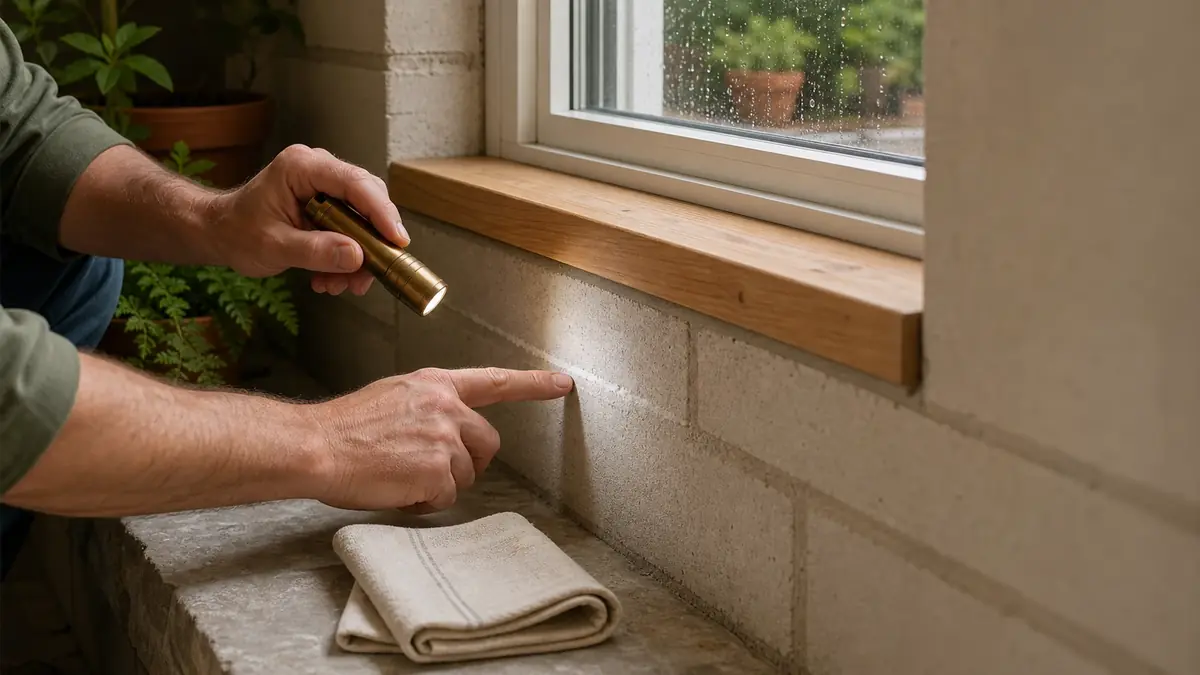
Brick, concrete block, stone, and other masonry can develop efflorescence. Water moving through masonry carries dissolved salts. When that water reaches the surface and evaporates, it can leave a whitish salt deposit. That's a mineral deposit, not fungal growth.
That mechanism changes the next question. Instead of asking which mold the color resembles, ask how water is entering or condensing and whether the deposit returns after the moisture condition changes. Appearance can make efflorescence a reasonable possibility on masonry, but it can't confirm the identity. A mineral deposit in one area also doesn't prove biological growth is absent elsewhere in a damp assembly. Basement moisture can take more than one route, so the useful next move is to understand the water path.
Wood is a separate decision. Surface mold or fungal stain isn't the same condition as white rot. White rot is a decay process that changes the wood itself, while mold and fungal stains may remain at the surface or discolor it. A pale patch can't establish decay or certify strength or salvageability. Wood that feels soft or spongy needs a qualified material or building assessment. So does wood that stays wet or changes shape. The distinction is explained in the Forest Service's guide to wood biodeterioration.
Drywall, ceiling tile, insulation, carpet, and other absorbent materials can hold contamination beyond the visible face. Porous materials may be difficult or impossible to clean completely. "Can it just be cleaned and painted over?" is the understandable shortcut. Assess damp or moldy material before cleaning or coating it; painting over it can create further problems.
Danger isn't a color scale
White mold isn't automatically harmless. Its color also doesn't make it toxic or more dangerous. Damp or moldy environments are associated with respiratory effects and with allergy or irritation, and some people have no effects at all. A patch can't show that it caused someone's symptoms.
Keep the building question and the health question separate enough to answer both well. Correct moisture and address affected material on the building side. If symptoms are new, severe, or worsening, discuss them with a qualified health professional. People with weakened immune systems shouldn't participate in or remain present during mold removal. That's a precaution for a defined vulnerable group, not evidence that every white patch is an emergency.
Decide what to do before disturbing it
Begin with the water. Look for a plumbing leak, rain entry, condensation, flooding history, or another moisture source that fits the location. These are possibilities to investigate, not diagnoses made from the patch. A clean-looking surface that stays damp isn't a finished repair. The decision isn't whether the patch can be made to disappear today. It's whether the material can stay dry after the visible mark is addressed. If that remains unknown, the moisture problem remains open.
A hard surface that can be cleaned and fully dried doesn't have the same limits as water-loaded drywall, carpet, insulation, or compromised wood. Porous materials can hold contamination beyond the visible face, and appearance can't establish the condition or salvageability of damaged material. This is the boundary appearance can't settle: whether the visible face contains the whole problem and whether damaged material can be restored. Those are material questions, not color questions. Correct the moisture source first. Use a removal method that fits the material and actual scope. Dry the area completely. Then watch for recurrence. The home cleanup guidance explains why porous materials and hidden growth can change that plan.
The question "can I DIY some bleach or vinegar solution to spray on it?" starts one decision too late. A cleaner can't correct water entry, tell you what lies behind a wall, or make a damaged porous material sound again. Bleach and other biocides aren't recommended as routine mold-cleanup practice, and simply killing mold isn't the same as removing it.
Area is one planning clue, with strict limits. EPA guidance says that in most cases a resident may be able to handle confirmed mold covering less than about 10 square feet. That number isn't a toxicity threshold, and it doesn't certify if the area is safe to occupy.
Now ask what can overrule it. Substantial water damage or hidden extent can. Damaged porous material can, too. HVAC involvement may change the plan, as may sewage or other contaminated water. Building stability is another stop sign. Recurrence or a vulnerable occupant also changes the plan. EPA's scope guidance keeps the affected material and continuing moisture beside area, because the number alone can't make the decision. Read the number only after those questions, not instead of them.
Choose help according to the unresolved question. Don't begin with a generic referral. Begin with the question that's still unanswered. Water entry or hidden extent goes to a qualified building or moisture professional. Material condition goes to a professional experienced with the affected material. HVAC involvement or contaminated-water damage calls for specialized building expertise. Symptoms stay with a qualified health provider.
If the same area returns after cleaning, the useful conclusion isn't that you chose the wrong cleaning solution. It's that the moisture-and-material problem isn't yet resolved.
Testing is a narrower decision
When visible mold is present, routine sampling is unnecessary in most cases before correcting moisture and addressing the material. Sampling may still be useful when a qualified professional has a narrow question and a plan for interpreting the result. Short-term sampling can't establish personal health risk or certify that a building is safe.
If you can't answer the moisture question before disturbing the patch, stop there. That's the building decision a white color can't make for you.
Medical information disclosure
Any health-related claims made on this site have not been evaluated by the Food and Drug Administration (FDA). The information provided on this site is not intended as a substitute for professional medical advice, diagnosis, or treatment. Always seek the advice of your physician or other qualified health provider with any questions you may have regarding a medical condition. MoldCo assumes no responsibility or liability for any errors or omissions in the content of the references, nor for any actions taken in reliance thereon.
About the author

MoldCo Editorial Team
Editorial Team
The MoldCo Editorial Team maintains MoldCo's public education library. The team works from MoldCo's product, clinical, and environmental review standards to keep content clear, sourced, and within appropriate medical and remediation boundaries.
Your next step
Not sure whether mold is part of your picture?
The first step is an intake that maps your symptoms and history. You get clarity first, then decide whether provider-guided care fits.
This article is informational and is not medical advice. MoldCo treats but does not diagnose CIRS.