Causes and Exposure
What Black Mold Looks Like, and What the Picture Misses
MoldCo Editorial Team
The short answer
Contents
Black mold may appear as dark green, greenish-black, or black spotting or patches. Stachybotrys chartarum, the species many people mean by "toxic black mold," is greenish-black and can grow on constantly wet, cellulose-rich material. But appearance can't confirm that species, show whether a mold is producing mycotoxins, or tell you how dangerous the patch is to you. "Black mold" is not one species category.
One first-time buyer asked it bluntly: "First time home buyers, bought house with fieldstone foundation. Is this mold or just normal discoloration?" They had seen "beads of moisture on the walls." After a trip, they returned to a space that felt "very musty/humid." None of that proves the mark is mold. It does show why the picture needs context.
A photograph can preserve clues. It can't confer a name. Use it as a record of a moisture-and-scope problem that may need action, not as a verdict delivered by color.
Why the patch refuses to identify itself
Mold doesn't keep one visual uniform. It can vary in color, form, and texture, and the same species can change appearance over time. The EPA's mold image library shows that range, but it is not a key for naming a sample.
The lookalikes are ordinary enough to fool a careful person. Paint changes, mineral or alkaline deposits, soot, dirt, and stains can resemble growth. A close photo may preserve surface and material clues, but it can't reliably separate every lookalike. EPA inspection guidance explains these visual limits. This is why cropping tightly around the darkest spot often removes the information that matters most.
That doesn't make looking useless. It changes the job.
Build a five-part visual record
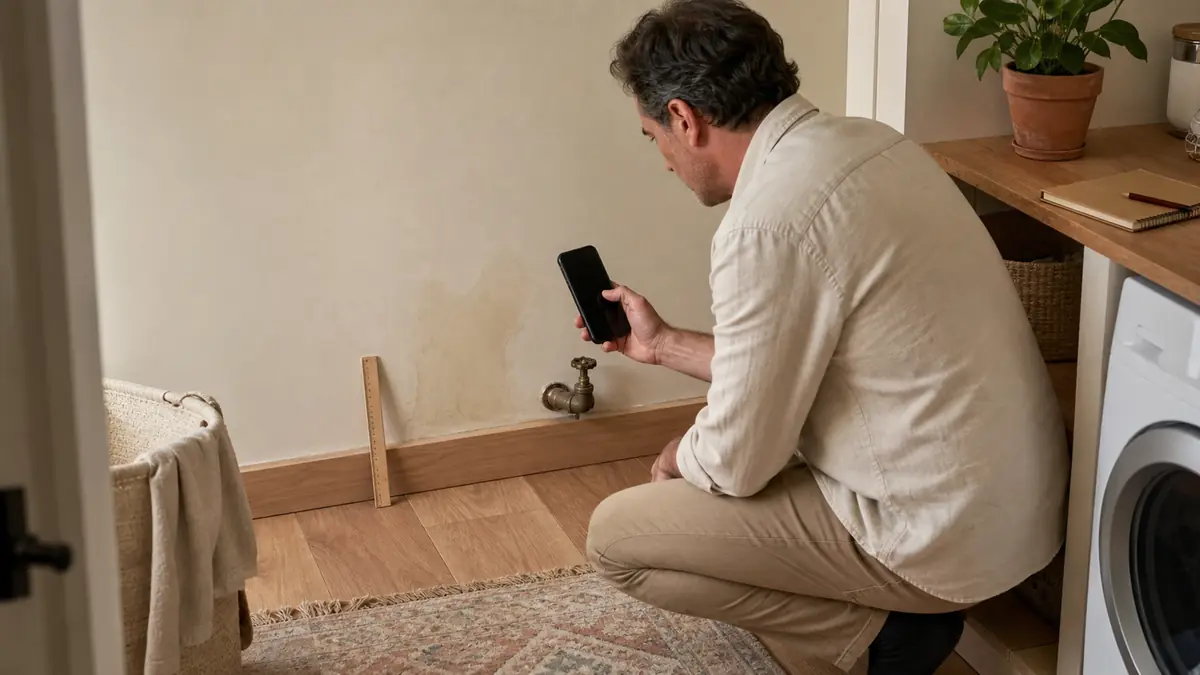
Take one close photo and one wider photo. Then write down the information the camera can't hold by itself.
-
Location and material. Record the room and surface, then photograph what lies beside the mark. Don't guess what is behind it. A dark mark on sealed tile raises a different cleanup question than one on porous drywall or ceiling tile. A nearby vent doesn't place the mark inside the heating or cooling system.
-
Moisture history. Put the damp clues beside the dark mark in your record, just as the fieldstone-basement buyer did with wall moisture and mustiness. Note any leak, flooding, condensation, wet insulation, drainage trouble, or dampness. Record the last time you know the material was dry. Indoor mold growth points to a water or moisture problem, which is why source correction matters more than guessing a species.
-
Visible area. Include a ruler or another known-size object without touching the patch, and photograph separated spots that may belong to the same wet area. EPA uses roughly 10 square feet as a practical cleanup-scope guide. It isn't a safety cutoff. Size alone can't settle the job after contaminated water or when the edge is hidden. Porous damage and moisture reaching a heating or cooling system also change the question. A smaller patch still carries cleanup risk for people with allergies or asthma. The same is true for people with COPD, immune suppression, and underlying lung disease.
-
Change over time. Date the first image. Return to the same position for the next one, then compare the two. A dark stain that stays the same after cleaning is not proof of active growth. If visible material returns or spreads beyond the old boundary, investigate whether moisture persists. Damaged material or growth you can't reach may explain the change, but the pictures alone can't tell you which.
-
A visible water or system connection. Start with any nearby water source you can photograph safely. Record wet insulation or condensate trouble. Photograph visible growth on a heating or cooling component only from a safe position. A register in the frame shows proximity. It doesn't prove duct contamination. If one of those moisture or component clues is present, bring experienced guidance into the next step. EPA guidance on air ducts draws the same practical boundary.
The record should help another person understand the building question without asking you to stare harder at the black part.
Let the record decide the handoff
If the mark appears to be visible growth, address the moisture source and define the physical scope before pursuing a species label. A limited patch on a nonporous surface, with the water source understood, may be a more contained job. Porous damage or an uncertain boundary calls for a wider look. Extensive water damage or contaminated water raises the need for experienced help. MoldCo does not inspect or remediate buildings. Use the black mold guide for category questions and the black mold removal guide for cleanup decisions.
After the work, put the dated photos side by side. An unchanged stain can't prove active growth. Visible material that returns or spreads is a reason to investigate the moisture source and the edge of the affected area. If that edge is hidden or uncertain, an experienced independent environmental professional can help define it. Those are scope problems, not color problems. The inspection and detection guide explains what a fuller building assessment should answer.
For a heating or cooling system, ask what connects the patch to the equipment. A nearby register proves only that the two are near each other. Wet insulation, a condensate problem, or visible component growth is the point to seek experienced guidance.
Before sampling, write down what action each possible result would change. Visible mold usually does not need routine sampling, and a short-term air count can't be converted into a personal health-risk score. There is no federal airborne mold standard that makes one result a safety certificate. Targeted professional sampling can still help when it answers a narrower question that remains.
People with allergies, asthma, COPD, immune suppression, or underlying lung disease should not take part in mold cleanup. People with immune suppression or underlying lung disease should also avoid moldy spaces and cleanup exposure.
Severe breathing difficulty or a serious allergic reaction calls for urgent medical care. If you are pregnant or the concern involves a child, get qualified medical guidance before considering a commercial next step. A photo can't establish that mold caused a symptom or declare a room safe; the black mold danger guide handles that health-risk question in more depth.
This is also why we will not pitch you a test here. When mold is visible, the honest first move is moisture correction, scope, and appropriate cleanup. A test should answer a distinct question that remains after that work, not delay it or pretend to identify the patch.
Any health-related claims made on this site have not been evaluated by the Food and Drug Administration (FDA). The information provided on this site is not intended as a substitute for professional medical advice, diagnosis, or treatment. Always seek the advice of your physician or other qualified health provider with any questions you may have regarding a medical condition. MoldCo assumes no responsibility or liability for any errors or omissions in the content of the references, nor for any actions taken in reliance thereon.
About the author

MoldCo Editorial Team
Editorial Team
The MoldCo Editorial Team maintains MoldCo's public education library. The team works from MoldCo's product, clinical, and environmental review standards to keep content clear, sourced, and within appropriate medical and remediation boundaries.
Your next step
Not sure whether mold is part of your picture?
The first step is an intake that maps your symptoms and history. You get clarity first, then decide whether provider-guided care fits.
This article is informational and is not medical advice. MoldCo treats but does not diagnose CIRS.
Keep reading
Causes and Exposure
5 Signs of Black Mold in Your House: What the Clues Can Tell You
August 14, 2026 · 6 min read

Causes and Exposure
Do Air Purifiers Help With Mold? Name the Job First
August 1, 2026 · 7 min read

Causes and Exposure
Mold on Walls: What to Do When It Keeps Coming Back
July 29, 2026 · 6 min read